

 English
 한국어
한국어 日本語
日本語 中文 (中国)


Traditional braces in Vietnam are one of the most common and long-standing orthodontic methods, widely used for decades to correct dental misalignment and bite problems. Thanks to their high durability, proven effectiveness, and reasonable cost, traditional metal braces remain a top choice for many patients, from children and teenagers to adults.
Despite the emergence of modern orthodontic solutions such as clear aligners and ceramic braces, traditional braces in Vietnam continue to play an essential role in clinical orthodontics, especially for complex cases that require strong and stable orthodontic forces.
1. What Are Traditional Braces?
Traditional braces, also known as metal braces, are an orthodontic system consisting of small brackets made of stainless steel or metal alloys that are bonded directly onto the surface of each tooth. These brackets are connected by an archwire and secured with elastic bands (rubber ligatures). Modern brackets are typically made from medical-grade stainless steel containing chromium and nickel for durability and corrosion resistance.
The archwire applies continuous force through the brackets, gradually moving the teeth into their desired positions over time. Orthodontic forces usually range from 50–150 grams, which is biologically optimal for safe tooth movement. Teeth typically move at an average rate of 0.5–1 mm per month, depending on age and bone metabolism. Orthodontists adjust the wire every 4–8 weeks to maintain controlled pressure and ensure precise alignment along the dental arch.
Compared to clear aligners or ceramic braces, traditional braces in Vietnam utilize the strength and resilience of metal materials. Their rigidity allows them to manage moderate to severe crowding (>6 mm space deficiency), large overjet cases (>6 mm), deep bite (>4–5 mm overlap), and complex bite discrepancies. Globally, metal braces still account for approximately 50–60% of orthodontic treatments, especially in adolescent patients.
2. Advantages of Traditional Braces in Vietnam
One of the biggest advantages of traditional braces in Vietnam is their high treatment efficiency. Metal braces can handle a wide range of orthodontic problems, from mild misalignment to severe cases such as crossbite, deep bite, open bite, and significantly rotated teeth. Clinical studies show that treatment success rates are comparable or superior to other fixed systems in complex cases.
Another major benefit is durability. Metal brackets have a low fracture rate (generally <5% breakage rate during treatment when properly maintained). Their resistance to impact makes them suitable for teenagers and active individuals.
Cost is also a key factor. In Vietnam, traditional metal braces typically cost around 25–40 million VND, which is often 30–50% less expensive than ceramic braces and significantly lower than clear aligners (which may range from 70–120 million VND). This makes them accessible to students, young professionals, and families with budget considerations.
In addition, treatment time with traditional braces is often efficient. Comprehensive orthodontic treatment usually lasts 18–24 months for moderate cases and up to 24–36 months for complex cases. Because metal braces can generate strong and stable forces, tooth movement may be more predictable, potentially reducing the need for refinements.
See more: Orthodontic Treatment in Vietnam
3. Disadvantages of Traditional Braces
Despite their effectiveness, traditional braces in Vietnam also come with some drawbacks.
The most noticeable limitation is aesthetics. Metal brackets and wires are clearly visible when worn. Surveys show that up to 40–60% of adult patients prefer less visible orthodontic options for professional or social reasons.
Another issue is oral hygiene. Brackets and wires increase plaque retention by approximately 20–30%, making cleaning more difficult. Without proper care, the risk of gingivitis may rise (affecting up to 30–40% of orthodontic patients with poor hygiene), and white spot lesions (early enamel demineralization) may occur in 20–35% of fixed-brace patients.
Traditional braces may also cause discomfort, particularly in the first few weeks. Pain levels are usually reported as 3–6/10 on the VAS scale, peaking within 24–48 hours after adjustment and subsiding within 3–7 days. Soft tissue irritation is common during the first 1–2 weeks, but most patients adapt within 2–4 weeks.
4. Popular Types of Traditional Braces in Vietnam
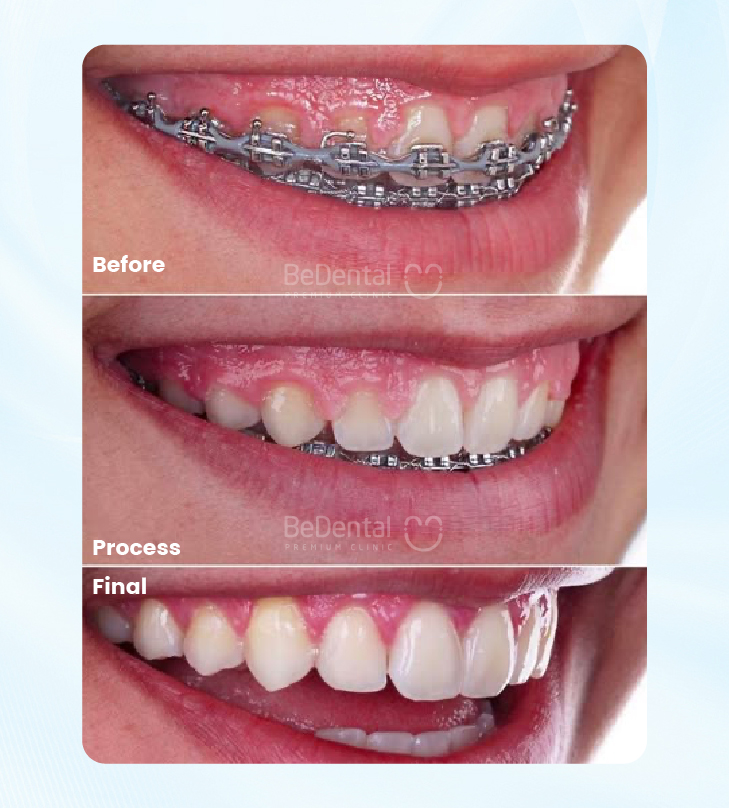
Although traditional braces are considered a classic orthodontic method, modern dentistry has developed several variations of metal braces to suit different needs, comfort levels, and budgets.
| Criteria | Conventional Metal Braces | Self-Ligating Metal Braces | Lingual Metal Braces (Inside Braces) | Mini Metal Braces |
| Key Features | Use elastic ligatures (rubber bands) to hold the archwire in bracket slots | Built-in sliding mechanism or clip instead of elastic bands (e.g., Damon, 3M SmartClip) | Brackets bonded to the inner surface of teeth, facing the tongue | Smaller, more compact brackets with rounded edges |
| Main Advantages | – Most affordable option – Effective for most orthodontic cases – Customizable elastic colors | – Reduced friction – Less discomfort – Potentially faster treatment (3–6 months shorter) – Fewer clinic visits | – Virtually invisible – Similar effectiveness to external braces – Ideal for aesthetic concerns | – More comfortable – Less cheek/lip irritation – Suitable for smaller mouths – Effective treatment outcomes |
| Main Disadvantages | – Higher friction – Slower tooth movement – Rubber bands require replacement – May stain | – Higher cost (10–15 million VND more than conventional braces) – Slightly bulkier initially | – Most expensive option – Technically complex – Initial speech difficulty and tongue irritation | – Slightly higher cost than conventional braces – Less widely available |
5. How to Choose the Right Traditional Braces in Vietnam
Choosing the right type of traditional braces depends on several factors, including budget, lifestyle, comfort expectations, and aesthetic priorities.
| Type of Braces | Best For | Key Benefits | Considerations | Budget Level |
| Conventional Metal Braces | Students and budget-conscious patients | – Most affordable option
– Highly reliable and effective – Suitable for almost all orthodontic cases |
– May cause more initial discomfort
– Requires frequent elastic replacement – More visible |
Low |
| Self-Ligating Metal Braces | Busy adults and professionals | – Reduced friction and pain
– Shorter treatment time – Fewer clinic visits – More convenient overall |
– Higher cost than conventional braces
– Slightly bulkier brackets at first |
Medium–High |
| Lingual Metal Braces | Public-facing professionals (teachers, presenters, actors, consultants) | – Virtually invisible – Maintains professional appearance
– Effective for complex cases |
– Highest cost
– Initial speech discomfort – Requires highly skilled orthodontist |
High |
| Mini Metal Braces | Teenagers, first-time patients, sensitive oral tissues | – Smaller and more comfortable
– Reduced cheek/lip irritation – Aesthetic improvement compared to standard metal braces |
– Slightly higher cost than conventional braces
– Not available at all clinics |
Low–Medium |
BeDental – A Trusted Dental Clinic for Braces in Vietnam

Founded in 2012, BeDental has become one of Vietnam’s reputable dental systems specializing in orthodontic treatment, with clinics in both Hanoi and Ho Chi Minh City. Over 12 years of operation, the clinic has treated more than 5,000 patients, including over 1,500 orthodontic cases. Approximately 70% of braces patients are adults, and overall treatment completion rates exceed 95%.
From the first consultation, patients undergo comprehensive oral examinations, including enamel assessment, gum evaluation, bite analysis, and jaw structure review. More than 85% of orthodontic cases are planned using 3D intraoral scanning and digital simulations, supported by Cone Beam CT imaging when indicated. This digital workflow has improved treatment precision by an estimated 25–30% and, in selected cases, reduced treatment time by 3–5 months.
Each treatment plan is fully customized, outlining the type of braces, orthodontic techniques, estimated duration, and staged progress expectations. Complex malocclusion cases account for nearly 40% of treated patients, reflecting the clinic’s experience in managing advanced orthodontic conditions.
BeDental emphasizes transparent pricing, with all costs clearly explained upfront and no hidden fees. Flexible 0% interest installment plans are available to improve financial accessibility. Internal surveys show patient satisfaction rates above 94%, particularly in communication clarity and treatment transparency.
During treatment, supportive procedures such as periodontal therapy or enhanced hygiene protocols may be recommended to optimize outcomes. Follow-up adherence exceeds 90%, and in cases of inflammation or delayed tooth movement, orthodontists proactively adjust strategies and inform patients promptly.
With experienced specialists, standardized medical protocols, and continuous investment in modern technology, BeDental positions itself as a reliable and clinically accountable destination for professional orthodontic care in Vietnam.
Patient Stories at BeDental
Patient Story 1
Patient: Long, 21 years old – University Student (Hanoi)
Concern: Severe overbite and protruding upper teeth
Long came to BeDental feeling insecure about his smile. His upper teeth significantly overlapped his lower teeth, causing both aesthetic concerns and difficulty chewing. He often covered his mouth when laughing and avoided taking close-up photos.
After a comprehensive examination using digital X-rays and 3D bite analysis, BeDental orthodontists diagnosed a severe overbite combined with dental protrusion.
Treatment Plan:
- Self-ligating metal braces
- Interarch elastics for bite correction
- Estimated duration: 26 months
During treatment, Long attended regular follow-ups every 4–6 weeks. The reduced-friction system helped minimize discomfort, and the orthodontic team closely monitored bite improvement at each stage.
Results after 25 months:
- Balanced bite relationship
- Retracted protrusion
- Improved facial profile
- More harmonious smile line
Long shared that the biggest change was not only physical but psychological. He now smiles confidently in social situations and feels more self-assured when presenting at school.
Patient Story 2
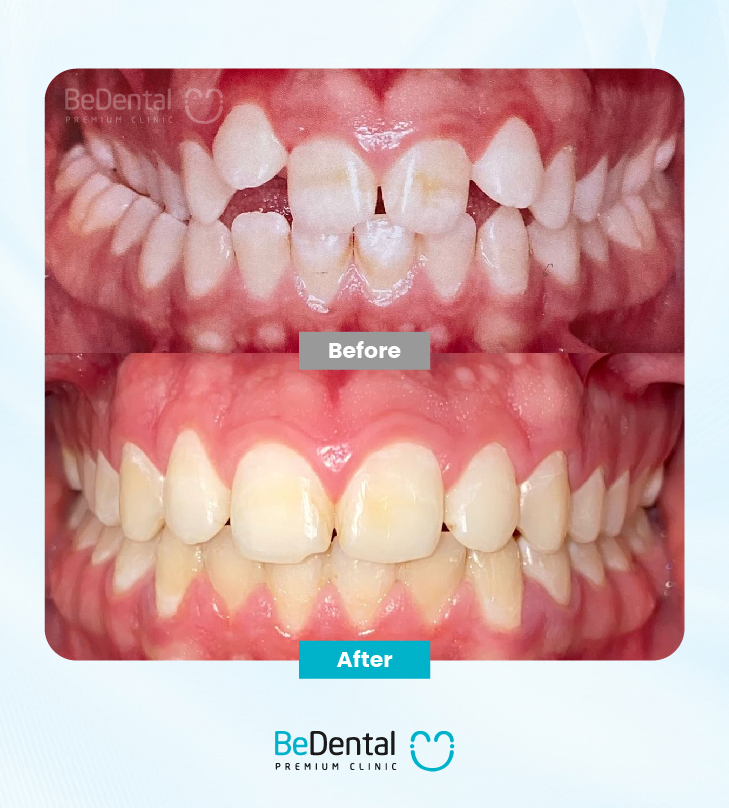
Patient: Mai, 32 years old – Corporate Consultant (Ho Chi Minh City)
Concern: Moderate spacing and mild crossbite
Mai wanted to correct the gaps between her front teeth but was concerned about wearing visible braces during client meetings and conferences.
After consultation at BeDental, lingual metal braces were recommended to maintain aesthetics while effectively correcting her bite.
Treatment Plan:
- Lingual metal braces (inside braces)
- Mild crossbite correction
- Estimated duration: 20 months
The first few weeks required adaptation, particularly with speech and tongue comfort. However, with guidance from BeDental’s orthodontic team, Mai adjusted quickly. Regular monitoring ensured steady progress and precise alignment.
Results after 19 months:
- Fully closed spacing
- Improved bite stability
- Completely invisible orthodontic process
- Maintained professional appearance throughout treatment
Mai described her experience as “discreet, structured, and professionally managed.” She especially appreciated the clinic’s automated reminders, detailed hygiene instructions, and long-term retainer guidance after braces removal.
Final Thoughts on Traditional Braces in Vietnam
If you are considering traditional braces in Vietnam, the best approach is to consult a reputable dental clinic like BeDental. A professional orthodontist will evaluate your oral condition and recommend the most suitable type of braces based on your needs, lifestyle, and budget.
With proper care and commitment, traditional braces in Vietnam can help you achieve a healthy, balanced bite and a confident, beautiful smile that lasts a lifetime.
See more: Does getting braces hurt? Which stage is the most painful?
Tại BeDental, khách hàng có thể an tâm điều trị với dịch vụ bảo lãnh viện phí nha khoa nhanh chóng và tiện lợi. BeDental hiện liên kết với nhiều công ty bảo hiểm uy tín, hỗ trợ thanh toán trực tiếp chi phí các dịch vụ nha khoa như nhổ răng, trám răng, điều trị tủy, phục hình răng sứ... Quy trình linh hoạt, minh bạch giúp tiết kiệm thời gian và tối ưu chi phí. Hãy liên hệ BeDental để được tư vấn chi tiết và tận hưởng trải nghiệm chăm sóc răng miệng chuyên nghiệp, không lo gánh nặng tài chính.
🔹 Các đơn vị nha khoa chấp nhận bảo lãnh bao gồm : Hùng Vương Insurance, Bảo Long Insurance, BSH (Bảo hiểm BSH), FWD Insurance Cathay Life Fubon Insurance, Tokio Marine Insurance Group VNI (Bảo hiểm Hàng không), HD Insurance MSIG AAA Insurance PTI (Bảo hiểm Bưu điện), BIDV MetLife, PJICO, Techcom, Insurance, AIA, Dai-ichi Life MIC GIC DBV Insurance VBI (Bảo hiểm VietinBank)
🔹 Các công ty bảo hiểm BeDental có thể xuất hóa đơn: Manulife Dai-ichi Life Prudential AIA Hanwha Life PVI VCLI (Bảo hiểm nhân thọ Vietcombank - Cardif) BIC (Bảo hiểm BIDV), Bảo Việt Insurance và PVI