
Kiến Thức Nha Khoa
Non-Prep Porcelain Crown in Vietnam: A Minimally Invasive Smile Solution
Th4

If you’ve ever worried about drilling, shaving or grinding your natural tooth for a crown, you’re not alone. Thankfully, an increasingly popular option is the non-prep porcelain crown in Vietnam — a method that allows for excellent aesthetics and function without aggressive tooth reduction. This article explores how and why the non-prep crown (also known as a crown without grinding or crown without prep) works, who it’s suitable for, what it costs in Vietnam, and how a top-clinic like BeDental executes it with world-class precision.
1. What is a Non-Prep Porcelain Crown?
A non-prep crown refers to a dental cap placed over an existing tooth with minimal or no removal of tooth structure. Instead of heavy shaping or grinding, the dentist may lightly polish or adjust the enamel surface, then bond a thin porcelain restoration over it. Because of this, terms like minimally invasive crown process, or crown without grinding, are often used.
While the concept originally emerged in the veneer space (so-called “no-prep veneers”), it’s expanding into full crown treatments — especially in cosmetic and tourism dentistry markets like Vietnam. The key benefit is that you retain more of your natural tooth, reduce the risk of sensitivity, and shorten healing time.
Clinical literature notes that ultra-thin ceramic restorations bonded to enamel can reduce pulp irritation and preserve tooth vitality. For example, a review observed that non-prep prosthetics preserve the enamel and show good durability.
2. Why Consider a Non-Prep Crown Instead of Traditional Grinding?
A traditional crown often requires ~1–2 mm of enamel/ dentin removal, reshaping the tooth to receive the cap. That means more invasive preparation, higher risk of sensitivity, and sometimes more time or cost. In contrast, a non-prep porcelain crown offers several advantages:
- Preservation of tooth structure: By avoiding or minimizing grinding, you keep more natural material.
- Reduced risk of post-op sensitivity: Less removal means less chance of nerve exposure or irritation.
- Faster and gentler recovery: Less trauma means you’re back to eating and smiling quicker.
- Appealing for dental tourism: International patients often prefer solutions that are less invasive and require fewer follow-up visits.
In the context of Vietnam’s dental market, using a non-prep crown can mean combining minimal invasion with high aesthetics and relatively lower cost.
3. Is a Non-Prep Crown Right for You? Indications and Limitations
While attractive, a non-prep crown is not suitable for every situation. Proper case selection is key. Some ideal scenarios include:
- Teeth that are slightly discolored or misshapen but structurally sound.
- Mild to moderate spacing or irregularities, where full grinding would be overkill.
- Patients who are proactive about dental hygiene and have good enamel quality.
But there are also limitations. If your tooth is severely decayed, root-canaled, misaligned, or lacking structure, a traditional crown (with core build-up and grinding) may still be necessary. As one dental review put it: “Non-prep veneers (and by extension crowns) are not suitable for severe orthodontic cases, large restorations or teeth with weak structure.”
In Vietnam, reputable clinics will evaluate your tooth via 3D scan, bite analysis and enamel integrity before recommending a non-prep crown.
4. The Non-Prep Crown Procedure in Vietnam
Here’s how the procedure normally unfolds when you choose a leading clinic in Vietnam such as BeDental:
Step 1 – Consultation & Assessment
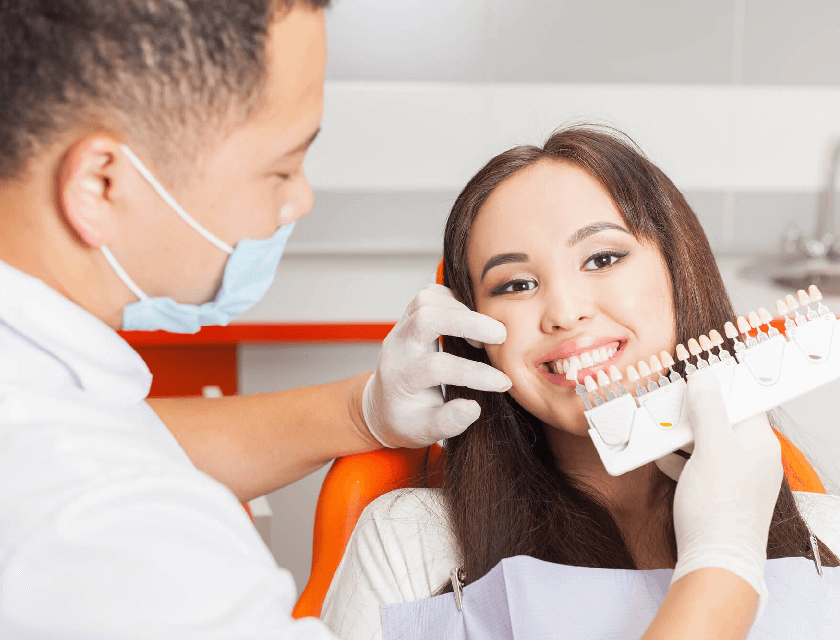
Your dentist (like Dr. Trang at BeDental) will perform a full oral exam, 3D scan or CBCT, and digital impression. They will evaluate if you are a candidate for a non-prep crown — checking enamel thickness, bite alignment, spacing, and aesthetic goals.
Step 2 – Minimal Enamel Preparation (if any)
Instead of heavy grinding, the dentist may only perform light polishing or shaving of sharp edges, ensuring the bonding surface is clean. This is why it’s called “crown without grinding”.
Step 3 – Digital Design & Custom Manufacture
Using CAD/CAM milling, the lab creates a custom porcelain crown that fits precisely. In Vietnam’s top clinics, this may happen in-house, enabling faster turnaround.
Step 4 – Bonding Without Significant Tooth Reduction
A special adhesive is used to bond the porcelain crown onto the existing tooth structure. Because the enamel is still intact, bonding tends to be stronger and longer lasting.
Step 5 – Final Adjustments & Bite Check
The dentist checks your new crown’s contact with adjacent/ opposing teeth, ensures comfort, and polishes for aesthetics. Because less tooth was removed, recovery is quick and sensitivity is minimal.
Thanks to the minimal preparation, many international patients in Vietnam complete the journey in 2–3 days rather than the standard 4–5 or longer abroad.
>> See more: Are Porcelain Crowns Good in Vietnam? 5+ things You Need to Know Before Getting
5. Benefits You Get with Non-Prep Crowns in Vietnam
Choosing a non-prep crown in Vietnam gives you a unique blend of advantages:
- You preserve more of your tooth — which is better in the long term for strength and vitality.
- You minimize the invasiveness and thus decrease sensitivity or discomfort.
- You often get state-of-the-art technology (digital scanning, CAD/CAM milling) with globally imported porcelain material.
- You benefit from lower cost dentistry in Vietnam compared to Western countries, without necessarily sacrificing quality.
- You enjoy the convenience of faster turnaround — appealing if you’re traveling for dental care.
6. Cost of Non-Prep Crown in Vietnam & What to Expect
When considering the cost of non-prep crown, Vietnam offers highly competitive pricing. While exact figures vary depending on material (type of porcelain/ceramic), number of units, and clinic reputation, you can expect a range similar to USD 300–600 per tooth at a reputable international dental clinic in Vietnam (including digital scanning, shade-matching, and finishing).
For comparison, in many Western countries the cost for ultra-thin crowns or conservative non-prep solutions may exceed USD 1,200–1,800 per tooth.
Importantly, while non-prep crowns may seem more expensive than the simplest standard crowns, they save cost and time in the long run because you avoid root canal risks, sensitivity, and possibly future retreatments. A reputable Vietnamese clinic will provide a detailed treatment plan, including material type, warranty, and any follow-up visits.
7. What to Know About Tooth Grinding, Sleep Teeth Grinding & Its Impact
One of the key concerns when discussing traditional crowns is tooth grinding (bruxism). Many patients ask: Does tooth grinding hurt? Does tooth grinding affect the longevity of a crown? Is grinding necessary?
In the context of non-prep crowns, less tooth removal means less risk of pulp exposure and less structural weakening of the tooth — both of which reduce pain risk after treatment. But ongoing grinding / bruxism still matters:
- If you grind your teeth, even a non-prep crown will face excessive stress and risk chipping or coming loose over time.
- Some patients worry that the dentist should grind (reduce) the tooth more so the crown sits better — but in non-prep cases, the precision bonding and fit compensate for less removal.
- If bruxism is present, your dentist should provide a night guard or talk about behavior modification to protect the restoration.
Simply put, non-prep crowns help reduce the need for tooth reduction, but they don’t eliminate the need for protecting against harmful bite habits.
8. Side Effects & Risks of Traditional Crown Grinding vs Non-Prep Approach
When a tooth is aggressively ground down for a traditional crown, several side-effects can occur:
- Increased sensitivity or pain from pulp/pulp chamber exposure.
- Higher risk of root canal or tooth death if too much structure is removed.
- Gum irritation or recession from poor margins and improper fit.
- Longer recovery time, more discomfort, and potential for complications.
The non-prep crown approach significantly mitigates these risks by preserving the enamel and avoiding deep tooth alterations. That said, it still requires excellent bonding, correct occlusion, and high-quality porcelain material. For example, durability studies show success rates for porcelain crowns exceed 90% after 10 years — but only in well-executed cases.
>> See more: Titanium Porcelain Crowns in Vietnam: Strength, Beauty, and Lasting Value
9. Why Vietnam Is Ideal for Non-Prep Crown Treatments
Vietnam is an increasingly recognized hub for dental tourism and minimally invasive cosmetic dentistry. Several factors make it ideal for a non-prep porcelain crown:
- Clinics frequently use advanced digital dentistry equipment, including intraoral 3D scanners and CAD/CAM labs, allowing quick turnaround from scan to crown.
- High-quality porcelain materials are imported from Germany, Switzerland and Japan, ensuring aesthetics and longevity.
- Costs remain significantly lower than Western markets, while staff are often trained abroad and many speak fluent English.
- Patients appreciate the hospitality, travel convenience and ability to combine treatment with a short stay in Vietnam.
If you choose a trusted clinic (like BeDental) and ensure you’re a good candidate for non-prep work, you can experience world-class dental care with minimal invasiveness and high aesthetic results.
| Category | Price | ||
|---|---|---|---|
| 1. Phục hình tháo lắp - (Tìm hiểu thêm...) Removable Denture (More detail...) | |||
| Giá Hàm nền nhựa thường Conventional Denture (More detail...) | (1teeth) | 4.000.000 | |
| Giá Hàm nền nhựa dẻo Flexible acrylic partial denture | (1teeth) | 5.500.000 | |
| Giá Hàm khung kim loại thường Cast metal partial denture | (1teeth) | 4.500.000 | |
| Giá Hàm khung Titan Titanium partial denture | (1teeth) | 6.000.000 | |
| 2. Răng giả (Tìm hiểu thêm...) False teeth | |||
| Giá Răng giả hàm tháo lắp nhựa nội Acrylic resin teeth -made in Vietnam | (1teeth) | 350.000 | |
| Giá Răng giả hàm tháo lắp nhựa Mỹ Acrylic resin teeth -made in USA | (1teeth) | 600.000 | |
| Giá Răng giả hàm tháo lắp sứ Porcelain teeth backed with metal | (1teeth) | 1.800.000 | |
| Máng nâng khớp Denture occlúion | 1.000.000 | ||
| 3. Phục hình cố định : Non-removable denture | |||
| Giá Sứ kim loại (Tìm hiểu thêm...) Porcelain teeth backed with metal | |||
| Giá Răng sứ kim loại thường (Ni,Cr) Porcelain teeth backed with metal (Ni,Cr) | 1.800.000 | ||
| Giá Răng sứ kim loại Vivadent france (Cr,Co) Porcelain teeth backed with metal Vivadent France (Cr,Co) | 1.800.000 | ||
| Giá Răng sứ kim loại Jelenko USA ( Cr, Co) Porcelain teeth backed with metal Jelenko USD (Cr,Co) | 2.000.000 | ||
| Giá Răng sứ kim loại titan Porcelain teeth backed with titanium | 3.500.000 | ||
| Giá Sứ không kim loại : (Tìm hiểu thêm) Non-metal Teeth | |||
| Giá Răng sứ Katana (bảo hành 7 năm) Porcelain Veneer Katana from Japan | 3.500.000 | ||
| Giá Răng sứ Venus ( bảo hành 7 năm) (Tìm hiểu thêm...) Porcelain Veneer Venus from Germany (More detail...) | 4.000.000 | ||
| Giá Răng sứ Roland ( bảo hành 10 năm) (Tìm hiểu thêm...) Porcelain Veneer Roland from Germany (More detail...) | 4.800.000 | ||
| Giá Răng sứ Roland HD (bảo hành 10 năm) (Tìm hiểu thêm...) Porcelain Veneer Roland HD from Germany | 5.900.000 | ||
| Giá Răng sứ Ceramill (bảo hành 10 năm)(Tìm hiểu thêm...) Porcelain Veneer Ceramil from Germany | 6.000.000 | ||
| Giá Răng sứ Emax Nanoceramics ( bảo hành 15 năm) Porcelain Veneer Emax from Germany | 7.000.000 | ||
| Giá Răng sứ HTsmile (Bảo hành 15 năm) (Tìm hiểu thêm...) Porcelain Veneer Htsmile from Germany (More detail...) | 7.000.000 | ||
| Giá Răng sứ Emax* Press Lithium Disilicate (Bảo hành 15 năm) (Tìm hiểu thêm...) Porcelain Veneer Emax press from Germany (More detail...) | 8.000.000 | ||
| Giá Răng sứ Cercon (Bảo hành 15 năm) (Tìm hiểu thêm...) Porcelain Veneer Cercon from Germany (More detail...) | 7.000.000 | ||
| Giá Răng sứ Nacera Pearl Shade ( bảo hành 10 năm) Porcelain Veneer Nacera from Germany | 10.000.000 | ||
| Giá Răng sứ Lava 3M Premium Plus ( bảo hành 15 năm) (Tìm hiểu thêm...) Porcelain Veneer Lava 3M Plus from USA (More detail...) | 9.000.000 | ||
| Giá Răng sứ Lava Esthentics ( bảo hành 15 năm) Porcelain Veneer 3M Lava Esthetic from USA | 12.000.000 | ||
| Giá Răng sứ Lisi Press (bảo hành 15 năm) (Tìm hiểu thêm...) Porcelain Veneer Lisi from Japan (More detail...) | 12.000.000 | ||
| Giá Răng sứ kim cương (Bảo hành trọn đời) Porcelain Veneer Diamond from USA | 16.000.000 |
10. Real Patient Story – Embracing a Non-Prep Solution
Let’s look at a real case: Michelle, a teacher from Singapore, sought a full smile enhancement. She was worried about traditional crowns and the “grinding” concept. At BeDental she consulted with Dr. Trang, who introduced the non-prep crown option for her front six teeth (which were slightly uneven and discolored). Because her enamel was healthy and alignment acceptable, they proceeded.
“When I heard ‘no grinding’, I was relieved,” Michelle says. “The treatment was smooth, and I was back to walking the streets of Hanoi the same day. Two years later, my teeth still feel natural, and no one can tell they’re crowns.”
This story highlights how non-prep crowns allow patients to preserve more natural tooth structure, shorten downtime, and still achieve a beautiful, long-lasting smile.
11. What to Ask Your Dentist Before a Non-Prep Crown
Before committing to a non-prep crown, here are some essential questions:
- Is my enamel thickness sufficient for a non-prep crown?
- Will you perform a full bite analysis to ensure stability?
- What material will be used for the porcelain?
- What warranty or follow-up care is included?
- Do you offer protection (night guard/retainer) if I grind my teeth?
- What happens if the bond fails or I chip the crown?
At clinics like BeDental, these questions are part of the standard consultation process. Dr. Trang emphasises:
“Non-prep doesn’t mean no planning. It means the planning is precise and the execution immaculate.”
12. Summary: Is a Non-Prep Porcelain Crown in Vietnam the Right Choice?
If you are looking for a crown that preserves your tooth, minimizes discomfort, and offers excellent aesthetics — then a non-prep porcelain crown in Vietnam is a compelling option. When treated at a reputable clinic like BeDental, you benefit from minimal invasiveness, modern technology, and a global-standard outcome — at a cost that makes sense.
Of course, it’s not right for everyone. Significant structural damage, misalignment or high bite forces may still require traditional crown preparation. But for many cosmetic and moderate restoration cases, the non-prep crown approach offers a future-proof solution with less sacrifice.
13. BeDental – The Minimally Invasive Cosmetic Crown Specialist
At BeDental Vietnam, the focus is on high-precision aesthetic dentistry paired with patient-centered care. Under the supervision of Dr. Trang, the clinic has treated thousands of international patients seeking conservative smile solutions — including non-prep crowns and ultra-thin restorations.
The clinic uses state-of-the-art CAD/CAM milling, digital shade matching, and protocols that allow completion of crown cases in as little as 2–3 visits. With English-speaking coordinators, transparent pricing, and 10-year material warranties, BeDental offers peace of mind for overseas patients.
If you’re considering a non-prep crown in Vietnam, BeDental offers a free consultation and digital mock-up to help you visualise your new smile before treatment begins. It’s not just about a crown — it’s about restoring your confidence with minimal compromise.
Conclusion
A non-prep porcelain crown in Vietnam stands out as a modern, minimally invasive solution for restoring your smile — blending aesthetics, comfort and longevity. With the right candidate, right materials and right clinic, you can enjoy a beautiful, natural-looking tooth that preserves your structure and lasts for years. And with respected providers like BeDental, you’ll find that world-class results are within reach.
If you’d like more personalised information, I can help you compare non-prep vs traditional crown costs in Vietnam, or walk you through what to expect in your first visit.
BEDENTAL - TOP STANDARD DENTISTRY SYSTEM
In HANOI
Address 1: 7B Thi Sach St, Ngo Thi Nham, Hai Ba Trung Dist, Ha Noi. - 0934.61.9090
Address 2: No 129 Hoang Ngan, Yen Hoa, Cau Giay Dist, Ha Noi. - 0934.61.9090
In HO CHI MINH
Address 1: 53 -55 -57 Pho Duc Chinh St, Nguyen Thai Binh, Dist. 1, Ho Chi Minh. - 0766.00.8080
Working: 9am - 8pm everyday
Website: https://bedental.vn/en/