
Câu chuyện khách hàng
Mai Chau Eco Lodge Review: Stay, Experience & Travel Guide
May

Mai Chau Eco Lodge is positioned as a quiet retreat in the heart of Mai Chau, a valley known for its rice fields, surrounding mountains, and ethnic minority villages. Located about 3–4 hours from Hanoi, the lodge feels noticeably removed from the pace and density of the city, offering a setting that is more open, slower, and closely connected to nature.
1. Introduction About Mai Chau Eco Lodge
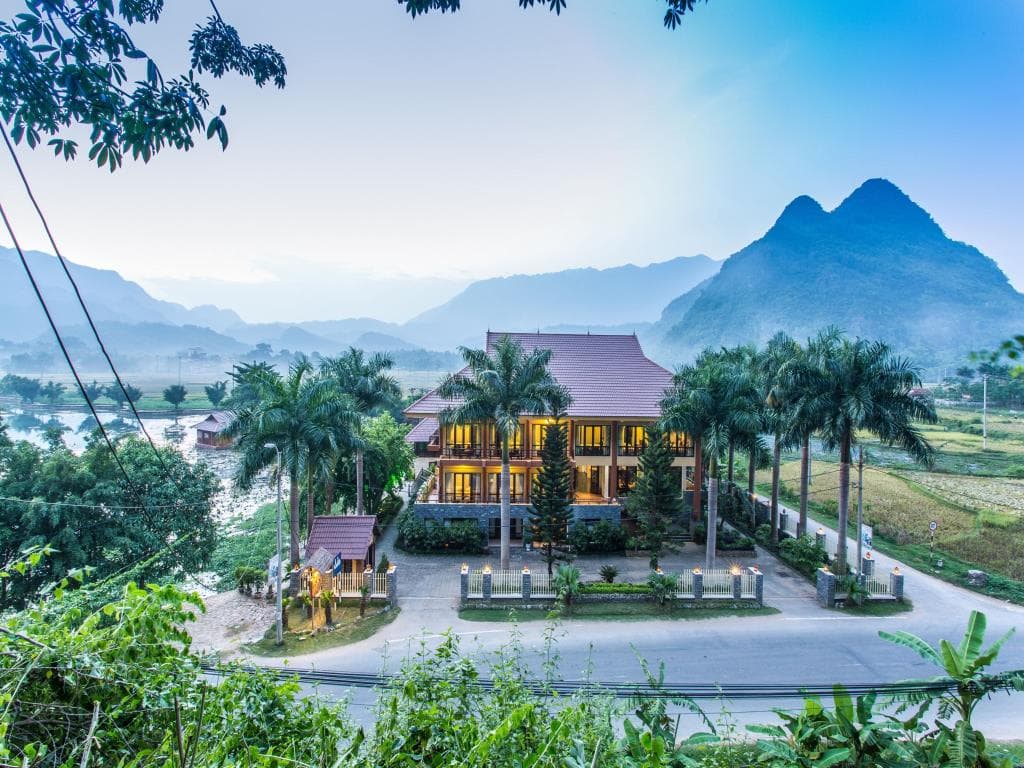
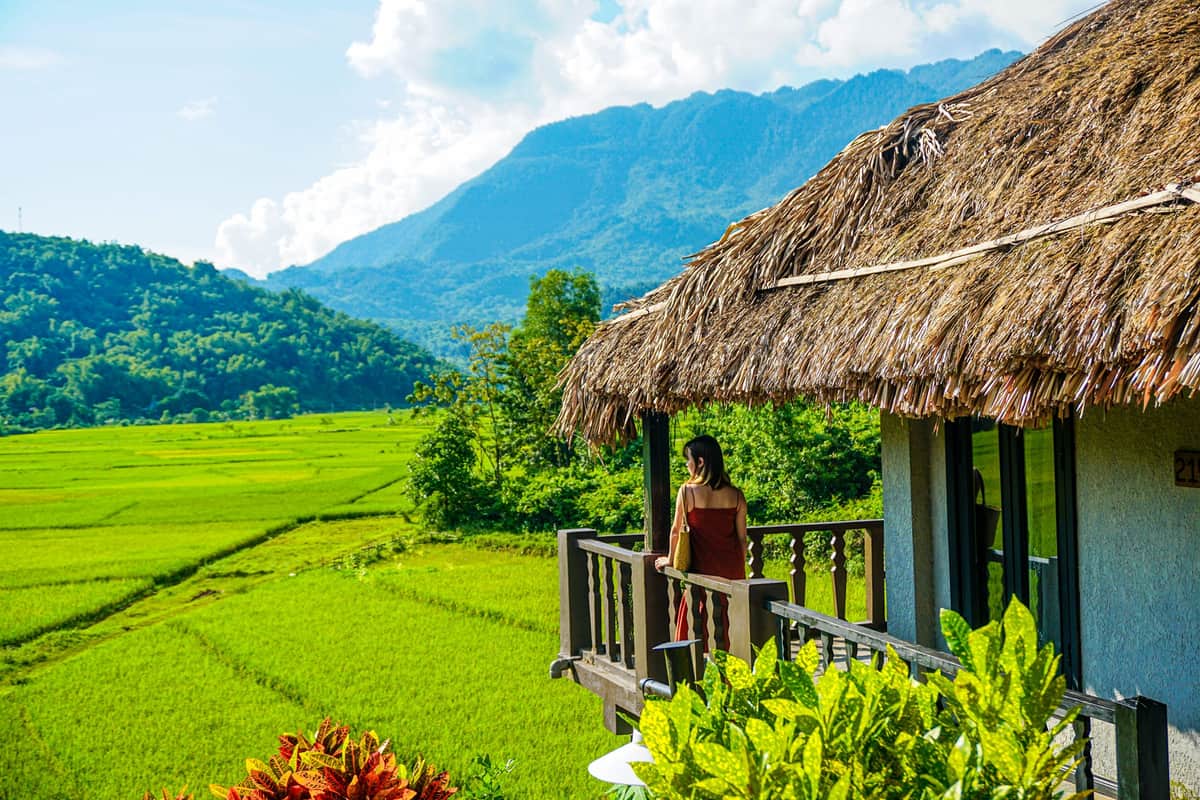
Built along a hillside overlooking the valley, the property blends traditional stilt-house architecture with more modern comfort, using wood, bamboo, and natural materials to create a space that feels integrated into its surroundings rather than separate from them. From most areas of the lodge, views extend across rice paddies and scattered village houses, giving a constant sense of landscape rather than enclosure.
Rather than focusing on luxury in a conventional sense, Mai Chau Eco Lodge leans toward an eco-luxury concept—where comfort exists, but is secondary to environment, atmosphere, and experience. The stay is less about activities or entertainment, and more about slowing down: walking through nearby villages, observing daily life, and spending time within a quieter, more rural setting. At its core, this is a place designed for nature, stillness, and cultural immersion, where the experience comes not from what you do, but from how you settle into the surroundings.
2. Location & Setting
2.1 Exact Location within Mai Chau
Mai Chau Eco Lodge is located in Nà Thia hamlet, Nà Phòn commune, on the quieter outer edge of Mai Chau. This positioning places it just beyond the more concentrated tourist villages such as Ban Lac Village and Pom Coong Village, creating a subtle but noticeable shift in atmosphere. While these villages are only a short distance away—around a few minutes by bike or car—the lodge itself feels more removed, with fewer passing visitors and a stronger sense of privacy.
2.2 Landscape & Surroundings
Built along a hillside, the lodge overlooks the full expanse of the Mai Chau Valley rather than being embedded within it. From this elevated position, the landscape opens outward in layers—rice fields stretch across the valley floor, interrupted by clusters of traditional stilt houses and lines of trees marking village boundaries.
What stands out is not just the view itself, but how it changes throughout the day and across seasons. In the early morning, the valley often feels soft and slightly misted, with light gradually revealing the patterns of the fields. By midday, the scenery becomes clearer and more defined, while late afternoon brings warmer tones and longer shadows across the land. Depending on the time of year, the fields shift from vivid green to golden yellow, or even to a more neutral, textured landscape after harvest. This constant variation makes the setting feel dynamic rather than static.
2.3 Connection to Local Villages
Despite its elevated and slightly secluded location, the lodge remains closely connected to nearby Thai ethnic communities. From the property, small paths lead down toward surrounding villages, where daily life continues at a steady, unhurried pace—farming, weaving, cooking, and small-scale local trade.
What makes this connection notable is how natural it feels. There is no clear boundary between “resort space” and “local space.” Moving from the lodge into the villages happens gradually, often just by walking or cycling along narrow paths that pass through rice fields and residential areas. This allows for observation without formality, where interaction is optional but always present in the background.
2.4 Accessibility & Journey from Hanoi
Reaching Mai Chau Eco Lodge from Hanoi typically takes around 3–4 hours by road, primarily via National Road 6. The journey itself forms part of the overall experience, as the environment gradually transitions from urban density to open countryside and eventually to mountainous terrain.
One of the most distinctive segments is passing through Thung Khe Pass, where the road winds through higher elevations and opens to wider views. After this point, the descent into Mai Chau becomes noticeably calmer—traffic thins out, the landscape flattens into the valley, and agricultural patterns begin to dominate the surroundings. By the time you reach the lodge, the sense of distance from the city is not just physical, but perceptual.
2.5 Atmosphere & Spatial Experience
The overall atmosphere of Mai Chau Eco Lodge is shaped by a balance between openness and quiet. The elevated position removes much of the ambient noise found in village centers, while still allowing visual and physical access to the surrounding environment.
Space here feels less confined—views extend outward rather than being enclosed by buildings, and movement is slower, with fewer external interruptions. At the same time, the lodge does not feel isolated in a disconnected way. Instead, it maintains a steady relationship with the valley below, where local life continues within sight but at a comfortable distance.
3. Accommodation & Room Types
3.1 Design & Architectural Style
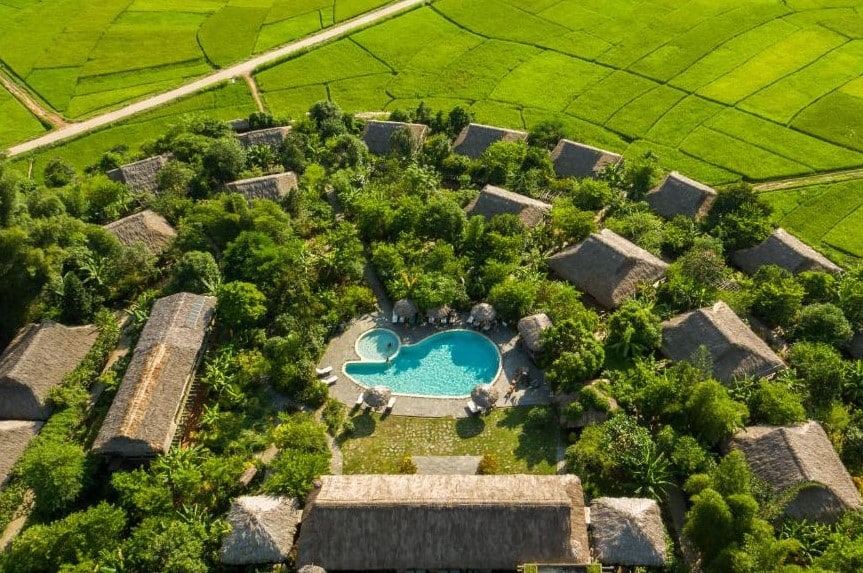
At Mai Chau Eco Lodge, the accommodation is built around a traditional stilt-house (nhà sàn) concept, adapted into a more refined, resort-style layout. Instead of large, uniform hotel blocks, rooms are arranged in smaller structures that follow the natural slope of the hillside, creating a sense of separation and privacy.
The architecture draws directly from local Thai ethnic houses, with elevated floors, sloping roofs, and open verandas. However, these elements are adjusted to provide more comfort and usability—balancing authenticity with practicality rather than strictly replicating traditional forms.
3.2 Room Categories
The lodge offers a range of room types, typically including:
- Deluxe Rooms The most standard option, designed for comfort with essential amenities. These rooms often have private balconies facing the valley, making them suitable for shorter stays.
- Bungalows More spacious and private, often positioned to maximize views. The layout feels more independent, with a stronger connection to the surrounding landscape.
- Suites The largest category, offering extended space, better positioning, and more open views. These are designed for a slower, more immersive stay rather than just overnight comfort.
Accommodation Overview – Room Types (Mai Chau Eco Lodge)
| Room Type | Space & Layout | Materials & Design | View | Experience Feel |
| Deluxe Room | Medium-sized room with a main sleeping area and a small balcony | Natural wood, bamboo accents, minimalist furniture (low bed, small table, warm lighting) | Garden or partial valley view | Cozy, simple, comfortable for short stays |
| Bungalow | More private standalone unit, often with a wider veranda | Wood and bamboo structure, more open layout, earthy textures | Open rice field and mountain views with less obstruction | Private, nature-connected, feels like staying “inside the valley” |
| Suite | Largest category with separate sleeping, lounging, and spacious balcony areas | Higher-quality natural wood, large glass panels, airy and open design | Panoramic view of Mai Chau Valley | Most immersive, relaxing, strong “slow living” experience |
While the categories differ in size and placement, the overall design language remains consistent across all room types.
3.3 Interior Experience (Concise Spatial Description)
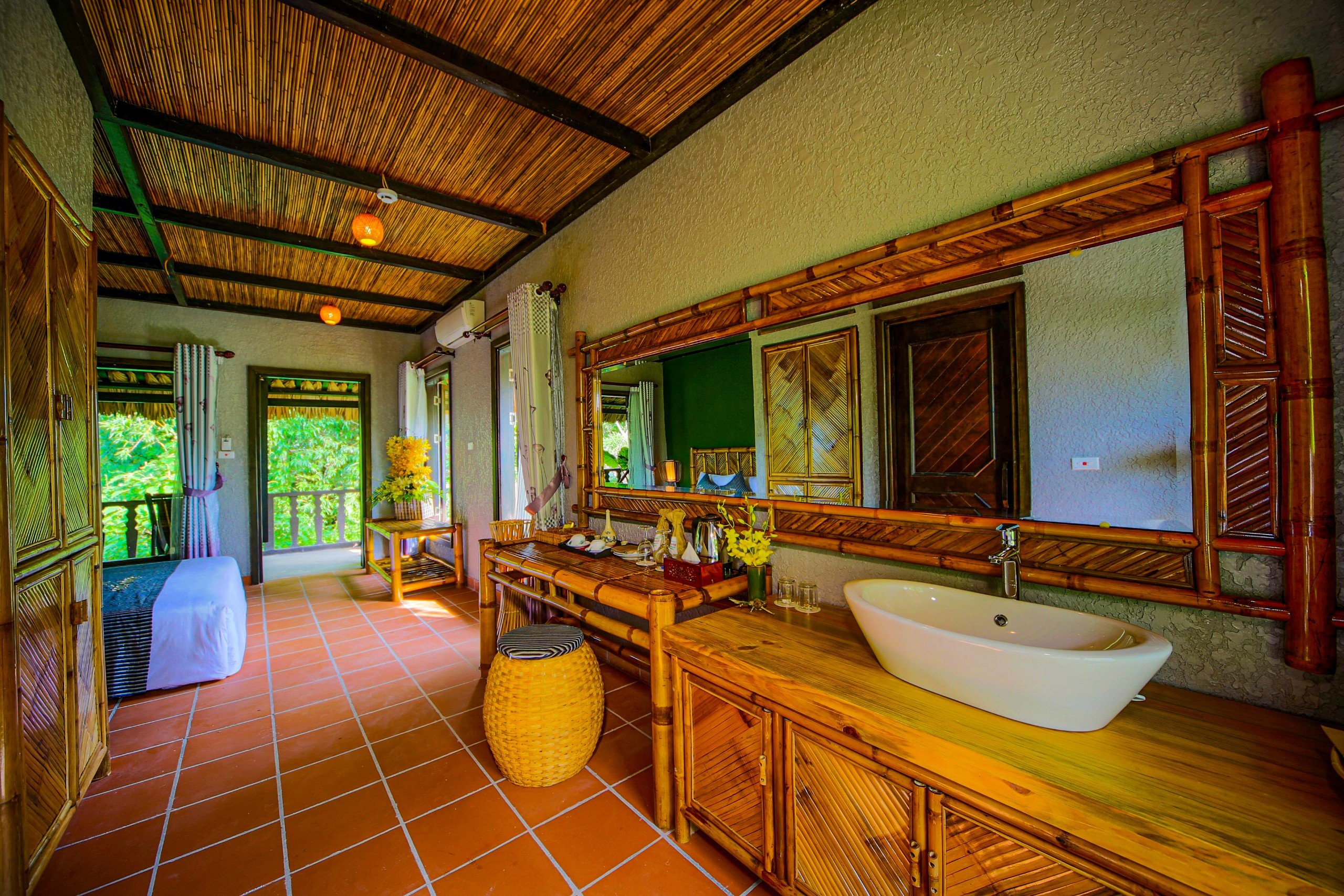
Inside Mai Chau Eco Lodge, the room is a long rectangular wooden space with a high, slightly sloped ceiling and exposed beams, creating an immediate sense of warmth and openness. From the entrance, the entire layout is visible in one straight line: a wooden floor leading past the bed and ending at full-height glass doors that open toward the balcony and the valley of Mai Chau. There are almost no visual barriers, so the room feels like one continuous flow rather than separated zones.
The bed sits directly on this main axis, facing the landscape. It is a low wooden frame in deep natural brown tones, paired with simple white or cream bedding and minimal cushions. Two small wooden bedside tables with warm yellow lamps sit on each side, creating a soft glow at night. Lying on the bed, your view naturally extends outward through the glass doors, so the outside landscape becomes part of the sleeping experience rather than something separate.
Near the window, a small sitting corner is arranged with rattan or wooden chairs and a compact table, always oriented toward the view instead of inward. It is positioned close enough to the bed to feel part of the same space, but visually it belongs more to the outside than the interior. This is where the room shifts from a sleeping space into an observation space.
The balcony continues this transition outward, with simple wooden flooring, minimal furniture, and an unobstructed view of rice fields and scattered stilt houses. The materials and color tones remain consistent with the interior, making the boundary between inside and outside feel almost invisible.
The bathroom is placed more discreetly at the back or side, designed in muted stone and wood tones with a glass shower partition. It is clearly functional but still follows the same natural material language, so it does not break the overall atmosphere.
Overall, the interior of Mai Chau Eco Lodge works as a single connected space where sleeping, sitting, and observing are not separated rooms, but different positions within one continuous wooden structure always oriented toward the open landscape of Mai Chau.
4. Things to Do & Local Experiences
Cycling through villages and rice fields
One of the most natural ways to experience Mai Chau is by renting a bicycle and slowly moving through the valley. The route usually passes narrow paths between rice fields, small wooden bridges, and clusters of traditional stilt houses. There is no fixed direction or “must-see stop”—the experience is about the rhythm of movement, the openness of the landscape, and the quiet presence of local daily life happening around you.
Walking / light trekking in surrounding hills
Beyond the flat rice fields, gentle hills surround the valley and can be explored on foot. These are not challenging trekking routes, but more like slow walks along dirt paths that gradually rise above the fields. From higher points, you can see the full structure of the valley—patches of green or gold rice fields, scattered houses, and distant mountain layers fading into the background.
Visiting local ethnic houses and handicraft workshops
Around the area, especially in nearby Thai ethnic communities, you can visit traditional stilt houses and small-scale craft spaces. Inside these homes or workshops, you may see weaving activities, textile production, or simple handmade goods being created. The experience is quiet and observational rather than performative—you are stepping into everyday life rather than a staged attraction.
Cultural performances (traditional dance & music)
Occasionally, cultural performances are organized within the lodge or nearby villages, featuring traditional Thai dance and music. These performances are usually small-scale, with simple staging and close audience interaction. The atmosphere feels informal, more like a community sharing its culture than a formal show.
Relaxing at the lodge (pool, views, reading spaces)
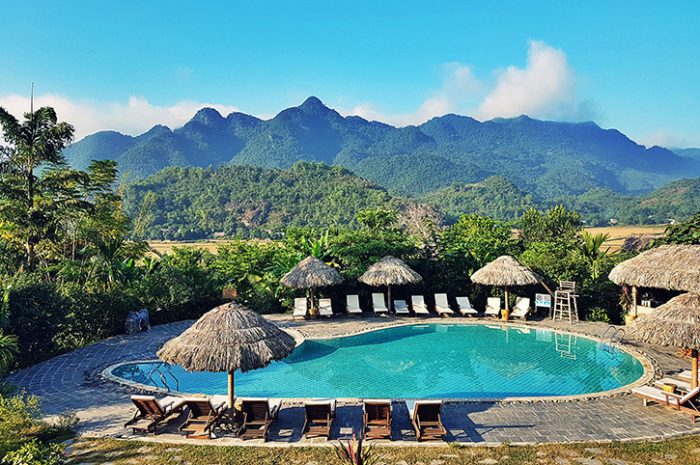
Not all experiences require moving outside. Within Mai Chau Eco Lodge, one of the main “activities” is simply slowing down—sitting by the infinity pool overlooking the valley, reading in open lounge spaces, or staying on the balcony watching the changing light over the rice fields. The environment itself becomes the experience, especially in the quiet hours of early morning or late afternoon.
The activities in Mai Chau Eco Lodge are not designed as structured entertainment, but as light, flexible experiences that keep you connected to the landscape and local rhythm of Mai Chau.
5. Food & Dining Experience
Dining at Mai Chau Eco Lodge is closely connected to the slow rhythm of Mai Chau, where meals are not just about eating but about spending time in a quiet natural setting. The menu is designed in a simple, approachable way, combining familiar Vietnamese dishes with regional mountain-style cooking, served in an open restaurant space overlooking rice fields and hills.
In the breakfast experience, guests are usually offered a combination of light international options and local Vietnamese staples. This may include phở bò or phở gà, bún chả, eggs prepared in different styles, fresh fruit, bread, butter, and basic pastries. Drinks typically include Vietnamese coffee, tea, and juices. Breakfast is often served in buffet or semi-buffet style depending on occupancy, and the price is generally included in the room rate, which averages around 80–150 USD per night depending on room type.
For lunch and dinner, the menu becomes more structured around Vietnamese and regional mountain cuisine. Common dishes include grilled chicken or pork with herbs, stir-fried seasonal vegetables sourced from nearby farms, braised fish or meat dishes cooked in clay-pot style, and simple rice-based meals served in shared portions. The cooking style is not heavy or overly complex, but focused on freshness and balance, reflecting the local food culture of the northern highlands.
A typical à la carte meal at the lodge ranges from around 5–10 USD per dish, while a full dinner per person usually falls within 15–25 USD, depending on selections and drinks. Compared to village eateries outside the resort, prices are higher, but still reasonable for a resort setting that includes service, ambiance, and location.
What shapes the experience most is not the individual dishes, but the environment in which they are served. The dining area is designed with large open views toward the valley, wooden interiors, and natural airflow, so meals feel like they are happening within the landscape rather than inside a closed restaurant. Light changes throughout the day—soft morning brightness during breakfast, warm golden tones at sunset dinner—making each meal feel slightly different even if the menu stays familiar.
Overall, dining at Mai Chau Eco Lodge is less about culinary innovation and more about comfort, consistency, and atmosphere, where simple Vietnamese dishes are elevated by the setting, and every meal becomes part of the wider experience of staying in Mai Chau.
Conclusion
Overall, Mai Chau Eco Lodge offers more than just a place to stay—it delivers a complete slow-living experience set within the natural landscape of Mai Chau. From its hillside location overlooking rice fields and mountains, to its wooden, nature-inspired architecture and open spatial design, everything is built around the idea of living in close connection with the environment rather than separating from it.
The accommodation feels intentionally simple yet thoughtful, where materials like wood, bamboo, and natural textiles shape a warm and grounded atmosphere. Rooms are not designed to impress through luxury detail, but through openness, light, and continuous visual connection to the valley outside. This same philosophy extends into the dining experience, where familiar Vietnamese dishes are served in a calm, open setting that allows the landscape to become part of the meal itself.
What makes the lodge stand out is not a single feature, but the consistency of experience across everything—staying, eating, resting, and exploring all follow the same rhythm: slow, quiet, and nature-centered. Activities such as cycling through villages, walking through rice fields, or simply sitting on a balcony all reinforce the feeling of stepping out of fast-paced urban life into a more grounded environment.
In the end, this is not a destination defined by intensity or constant activity, but by stillness and atmosphere. It is a place where the value lies in how little rush there is, and how naturally time seems to stretch. For travelers seeking a break from city rhythm and a deeper connection with landscape and local culture, Mai Chau Eco Lodge becomes less of a hotel and more of a temporary way of living within the quiet world of Mai Chau.
BeDental – A Leading Dental Clinic for International Travelers in Vietnam
BeDental offers high-quality dental services for international travelers visiting Vietnam, combining modern technology with experienced dentists. Our services include general and cosmetic dentistry, dental implants, teeth whitening, and smile makeovers, all performed to international standards.
Designed for tourists, BeDental provides flexible appointments, English-speaking staff, and personalized treatment plans that fit travel schedules. With competitive pricing and convenient locations, BeDental allows visitors to improve their smile while enjoying their trip to Vietnam.